

















Huawei eKit PoE Switch Guide: Power Budgets for CCTV, APs & VoIP

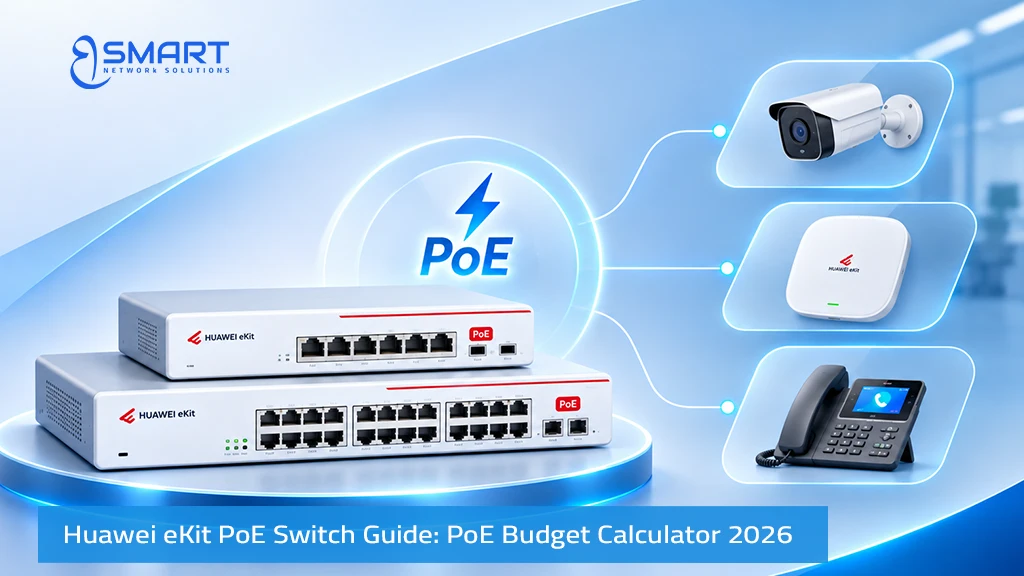
Choosing among Huawei eKit PoE switches is primarily a power-budget calculation rather than a simple port count. In Egypt, underpowered network installations often follow a common pattern: buyers count the required ports, select a standard 24-port PoE switch, and later discover that its total power budget cannot support all connected devices simultaneously.
This guide provides the sizing formula, decodes Huawei’s model letters, outlines worked calculation examples, and clarifies Perpetual PoE availability. For broader port planning, consult our guide on How to Choose a Huawei eKit Switch.
Quick answer: To size a Huawei eKit PoE switch, sum the maximum rated wattage of every connected device, apply a 25% planning margin (multiply by 1.25), and select a switch with an adequate total PoE budget. For example, 16 IP cameras at 10 W plus 4 Wi-Fi 6 access points at 18 W equals 232 W. Adding margin gives 290 W. A 195 W “LP” switch like the S220S-24LP4JX is too small. A 400 W “P” switch like the S220S-24P4J or S310-24P4S provides the required capacity.
What Is the Difference Between PoE, PoE+ and PoE++?
Three IEEE networking standards govern power delivery across Ethernet copper cabling:
| IEEE Standard | Industry Designation | Maximum Power per Port (Switch Side) | Typical Connected Endpoints |
|---|---|---|---|
| IEEE 802.3af | PoE (Type 1) | 15.4 W | Fixed IP cameras, basic desktop VoIP phones, IoT sensors |
| IEEE 802.3at | PoE+ (Type 2) | 30 W | Wi-Fi 6 access points, PTZ cameras, video touchscreens |
| IEEE 802.3bt | PoE++ (Type 3 / Type 4) | 60 W / 90 W | Wi-Fi 7 tri-radio APs, outdoor PTZ cameras with heaters, access control systems |
Two engineering rules govern these ratings. First, power ratings specify what the switch supplies at the port. Powered devices receive slightly less power due to electrical resistance and cable losses over long distance. Second, the maximum per-port capacity and the total switch PoE budget are distinct specifications. A switch port may support up to 30 W, while the overall chassis power supply might deliver a total pool of 195 W. Both constraints must be verified during system design.
How Much PoE Power Does Each Device Need?
Always size systems using the maximum power consumption listed on the manufacturer’s datasheet. Planning around typical or average draw leads to overcurrent shutdowns during night-time infrared illumination or peak wireless traffic.
| Powered Endpoint Type | Planning Wattage (Max Draw) | Engineering Sizing Considerations |
|---|---|---|
| Fixed IP bullet or dome camera | 6 W to 12 W | Draw peaks when infrared (IR) LEDs illuminate at night |
| Outdoor PTZ speed dome | 25 W to 30 W+ | Motor movement, wiper motors and integrated defrost heaters require PoE+ or PoE++ |
| Standard VoIP desktop phone | 5 W to 10 W | Basic monochrome phones draw ~5 W; backlit color consoles draw closer to 10 W |
| Wi-Fi 6 indoor access point | 12 W to 18 W | Dual-radio 802.11ax models require standard PoE+ (802.3at) |
| Wi-Fi 7 tri-radio access point | 22 W to 30 W+ | Dense multi-radio operation and 2.5G/10G interfaces demand high PoE+ or PoE++ power |
This answers a frequent presales question: how many PoE watts do IP cameras need? Fixed indoor and outdoor cameras generally require 6 W to 12 W. However, high-speed motorized PTZ domes with long-range infrared illumination require 25 W to 30 W or more, making rigorous power budget calculation essential for security deployments.
The PoE Budget Formula: A 4-Step Engineering Method
- List connected devices: Itemize every powered device and its maximum rated draw in watts.
- Calculate total connected load: Multiply device counts by maximum wattage and sum the results.
- Apply planning margin: Multiply the connected load by 1.25. The 25% allowance is a practical planning margin, not a universal IEEE requirement. Final sizing should account for device maximum input requirements, cable losses, startup behavior, power supply module options, and expected expansion.
- Select switch hardware: Choose a switch whose confirmed total PoE budget meets or exceeds the calculated load, while ensuring individual ports satisfy highest-draw endpoints.
Worked Calculation Example:
- 16 IP bullet cameras × 10 W = 160 W
- 4 Wi-Fi 6 access points × 18 W = 72 W
- Total connected load: 160 W + 72 W = 232 W
- Required budget with planning margin: 232 W × 1.25 = 290 W
- Conclusion: A 195 W “LP” switch will fail under peak load. A 400 W “P” switch provides sufficient power with 110 W of spare headroom.
LP vs P vs HP/U: Decoding Huawei eKit Model Numbers
Huawei eKit switches use descriptive letters in their part numbers to denote power capacity. Understanding these codes prevents underspecifying hardware:
- P = Standard PoE+: Delivers full-capacity PoE+ power budgets. On 24-port commercial switches, this designates models engineered for the 400 W power class.
- LP = Low-Power PoE+: Provides standard PoE+ (up to 30 W per port), but with a reduced aggregate power supply. Examples include the S220S-24LP4JX (195 W total budget) and S110-24LP2SR (180 W total budget).
- HP / U = High-Power PoE++: Engineered for heavy loads. The S310-24U4X delivers up to a 2,268 W PoE budget when configured with dual optional high-capacity power supplies.
- PN = Multi-Gigabit PoE+: Combines 2.5GBASE-T multi-gigabit access ports with PoE+, tailored for high-throughput Wi-Fi 6 and Wi-Fi 7 access points.
To understand the practical difference, consider average power across ports. On a 400 W 24-port switch, available power averages roughly 16.7 W per port. On a 195 W 24-port LP switch, available power averages roughly 8.1 W per port. These figures represent average available power across all ports, not the maximum power rating of an individual port. Actual power allocation depends on the switch’s per-port limits, connected device draw, and total PoE budget.
Selection Rule of Thumb: Deploy an LP model when connecting exclusively low-draw endpoints like fixed cameras and VoIP phones. Select a P model for mixed deployments containing cameras and wireless access points. Specify an HP or U model for outdoor PTZ domes, tri-radio Wi-Fi 7 access points, and access control hardware.
Huawei eKit PoE Switch Budget Lookup Table
The table below summarizes PoE capabilities across representative Huawei eKit models. Exact power budgets depend on factory power supply configurations and regional hardware versions. Always verify final figures on the official product datasheet before placing procurement orders.
| Model Number | Product Family | Power Tier | PoE Port Configuration | Total PoE Power Budget | Management Architecture |
|---|---|---|---|---|---|
| S110-8P2ST | S110 Series | Standard P | 8 × GE PoE+ ports | Model-specific (see datasheet) | Unmanaged plug-and-play |
| S110-16LP2SR | S110 Series | Low-Power LP | 16 × GE PoE+ ports | Model-specific (see datasheet) | Unmanaged plug-and-play |
| S110-24LP2SR | S110 Series | Low-Power LP | 24 × GE PoE+ ports | 180 W total budget | Unmanaged plug-and-play |
| S220-8P4S | S220 Series | Standard P | 8 × GE PoE+ ports | Model-specific (see datasheet) | Smart cloud managed |
| S220S-8P4J | S220S Series | Standard P | 8 × GE PoE+ ports | Model-specific (see datasheet) | Smart cloud managed (2.5GE SFP) |
| S220S-24LP4JX | S220S Series | Low-Power LP | 24 × GE PoE+ ports | 195 W total budget | Smart cloud managed (10GE SFP+) |
| S220S-24P4J | S220S Series | Standard P | 24 × GE PoE+ ports | 400 W class total budget | Smart cloud managed (2.5GE SFP) |
| S310-24P4S | S310 Series | Standard P | 24 × GE PoE+ ports | 400 W class total budget | Enterprise Layer 3 managed |
| S310-48P4X | S310 Series | Standard P | 48 × GE PoE+ ports | Model-specific 48-port budget (see datasheet) | Enterprise Layer 3 managed (10GE SFP+) |
| S310-48HP4X | S310 Series | High-Power HP | 48 × GE PoE++ ports | High-power budget class (see datasheet) | Enterprise Layer 3 managed (10GE SFP+) |
| S310-24U4X | S310 Series | Ultra-Power U | 24 × Multi-GE / GE ports | Up to 2,268 W (with dual high-power PSUs) | Enterprise Layer 3 managed (10GE SFP+) |
| S210I-8P4SX | S210I Industrial | Industrial PoE+ | 8 × GE PoE+ ports | Up to 220 W available (with 240 W module) | Hardened Layer 2 DIN-rail switch |
For detailed comparisons between unmanaged and smart managed series, see our S110 vs S220 vs S220S guide. For aggregation and industrial models, explore our S310, S530, S620 and S210I guide.
PoE Budget Calculation Examples for CCTV, Wi-Fi & VoIP
The following engineering calculations illustrate power budget planning for typical commercial installations across Cairo, Alexandria and Giza:
Scenario 1: Retail Shop Surveillance and Telephony
An installation comprises 8 fixed IP cameras (up to 12 W maximum draw each) and 1 VoIP phone (8 W maximum draw):
- Connected device draw: (8 × 12 W) + 8 W = 96 W + 8 W = 104 W
- Required budget with planning margin: 104 W × 1.25 = 130 W
- Physical port requirement: 9 PoE endpoints total. An 8-port switch lacks physical ports.
- Hardware recommendation: Select a 16-port PoE model such as the S110-16LP2SR for unmanaged setups, or a managed 16-port PoE model if you need centralized management and spare-port capacity. Verify its total PoE budget and port count against the final device list.
Scenario 2: Commercial Office with 24 Cameras and Wi-Fi
A multi-story office deployment combines 24 fixed IP cameras (10 W each), 6 Wi-Fi 6 access points (18 W each), and 5 VoIP desktop phones (8 W each):
- Camera power consumption: 24 × 10 W = 240 W
- Access point power consumption: 6 × 18 W = 108 W
- Telephone power consumption: 5 × 8 W = 40 W
- Total connected load: 240 W + 108 W + 40 W = 388 W
- Required budget with planning margin: 388 W × 1.25 = 485 W
- Physical port requirement: 35 PoE ports total
- Hardware recommendation: A single 24-port 400 W switch lacks both port density and wattage. Recommended topologies include deploying two 24-port 400 W switches such as two S220S-24P4J units (providing 800 W combined capacity), or a single 48-port switch such as the S310-48P4X if its datasheet budget exceeds 485 W. When using two switches, distribute powered devices evenly across both units to balance electrical loads, rather than relying solely on the aggregate 800 W figure. Separate surveillance, voice and guest traffic across distinct subnets as detailed in our VLAN configuration guide.
Scenario 3: High-Power Wi-Fi 7 and Motorized PTZ Deployment
A perimeter security and wireless project incorporates 6 tri-radio Wi-Fi 7 access points (30 W each) and 8 outdoor PTZ speed domes with infrared heaters (30 W each):
- Access point power consumption: 6 × 30 W = 180 W
- PTZ camera power consumption: 8 × 30 W = 240 W
- Total connected load: 180 W + 240 W = 420 W
- Required budget with planning margin: 420 W × 1.25 = 525 W
- Engineering analysis: This load exceeds standard 400 W power supplies. Furthermore, individual devices operate at the upper limit of PoE+ (30 W), eliminating per-port safety margins.
- Hardware recommendation: Deploy high-power switching platforms such as the S310-48HP4X or the S310-24U4X. Verify the high-power budget on the datasheet before finalizing quotations. For hospitality projects with dense room APs, see our hotel Wi-Fi solution guide.
High-Availability Power Features: Perpetual PoE, Fast PoE & PoE Watchdog
For mission-critical security and communications, Huawei eKit incorporates advanced availability features designed to keep edge endpoints energized:
| Advanced Availability Feature | Operational Mechanism | Primary Technical Benefit | Hardware Availability |
|---|---|---|---|
| Perpetual PoE | Maintains uninterrupted power to PoE ports during switch warm reboots and firmware upgrades | Surveillance cameras and APs stay powered without rebooting during maintenance | Model and firmware dependent (S310 and selected S220S models) |
| Fast PoE | Restores power to connected endpoints within seconds of AC restoration, before switch OS loads | Drastically reduces downtime for emergency VoIP phones and security cameras | Model and firmware dependent (S310 and selected S220S models) |
| PoE Watchdog | Monitors device responsiveness and automatically power-cycles non-responsive ports | Recovers frozen IP cameras and APs automatically without on-site service visits | Model and firmware dependent |
In standard commercial switches lacking Perpetual PoE, performing a software update cycles power across all ports, causing connected cameras to reboot. This creates extended recording gaps while cameras recalibrate. With Perpetual PoE enabled, power delivery remains uninterrupted, limiting downtime strictly to the data plane restart.
When an IP camera freezes or fails to respond to ping packets, PoE Watchdog power-cycles the individual port. If the device remains offline following an automated power cycle, presales and field engineers should troubleshoot physical cabling and negotiated power as outlined in our Huawei eKit switch troubleshooting guide.
Field Installation Best Practices for Egyptian Environments
- Comply with the 100-meter copper distance limit: Ethernet standards restrict copper cable runs to 100 meters. For peripheral security runs exceeding 100 meters, deploy intermediate switches or extend links using fiber optic transceivers.
- Specify 100% solid copper cabling: Copper-clad aluminum (CCA) cabling has higher electrical resistance than pure copper. Under high PoE loads, CCA cables experience severe voltage drops and excess heat dissipation, leading to camera drops. Always install solid copper Cat6 or Cat6A cabling.
- Account for thermal margins in summer: High summer temperatures in Egypt reduce heat dissipation in unventilated wall-mount cabinets. Maintain a 1U ventilation gap between switches and avoid exceeding 80% continuous PoE load in non-conditioned enclosures.
- Maintain spare capacity for network expansion: While a 1.25 multiplier serves as the baseline planning factor, enterprise facilities and educational campuses planning Wi-Fi 7 additions should size power budgets with a 1.5 multiplier.
Huawei eKit PoE Switch FAQs
How do I calculate the PoE budget for a Huawei eKit switch?
Add the maximum wattage of every connected device, then multiply by 1.25 for a planning margin. For example, 16 cameras at 10 W and 4 Wi-Fi 6 APs at 18 W total 232 W. Multiplying by 1.25 yields 290 W. A 195 W LP switch is insufficient, so choose a 400 W P-class switch like the S220S-24P4J or S310-24P4S.
Which Huawei eKit PoE switch fits IP cameras and access points?
For mixed cameras and Wi-Fi 6 access points up to roughly 350 W connected load, select a 400 W P-class model such as the S220S-24P4J or S310-24P4S. For high-draw PTZ cameras and Wi-Fi 7 access points, choose a high-power HP or U model such as the S310-48HP4X or S310-24U4X.
How much PoE power should I reserve for a CCTV installation?
Reserve the total maximum power consumption of all cameras plus a 25% practical planning allowance. Fixed cameras typically require 6 W to 12 W each, while motorized PTZ cameras with infrared illuminators and heaters require 25 W to 30 W or more.
What is the difference between PoE, PoE+ and PoE++?
Standard PoE (IEEE 802.3af) delivers up to 15.4 W per port. PoE+ (IEEE 802.3at) delivers up to 30 W per port. PoE++ (IEEE 802.3bt) delivers 60 W to 90 W per port for high-draw hardware such as PTZ domes and tri-radio Wi-Fi 7 access points.
Does every Huawei eKit PoE switch support Perpetual PoE?
No. Perpetual PoE is model-specific and firmware-dependent. It is available on designated managed series such as the S310 and supported S220S models. Unmanaged S110 switches provide standard PoE+ without software-managed availability features.
Get a Verified PoE Power Calculation & Project Quotation
BSMART Networks presales engineers verify power budgets, calculate voltage drop over copper distances, and optimize equipment lists for projects across Egypt. To select equipment for your network, browse the Huawei eKit 24-port PoE switch and Huawei eKit 48-port PoE switch selections in our online catalog, read our foundational Huawei eKit buying guide, or submit your device list through the Huawei eKit Egypt hub for an authorized presales quotation.
Related Products
Huawei IdeaHub Heavy-Duty Wall Mount Bracket for 65/75/86 Displays (Wall Mount Bracket)
In stock
0,00 EGP
SKU:
Wall Mount Bracket
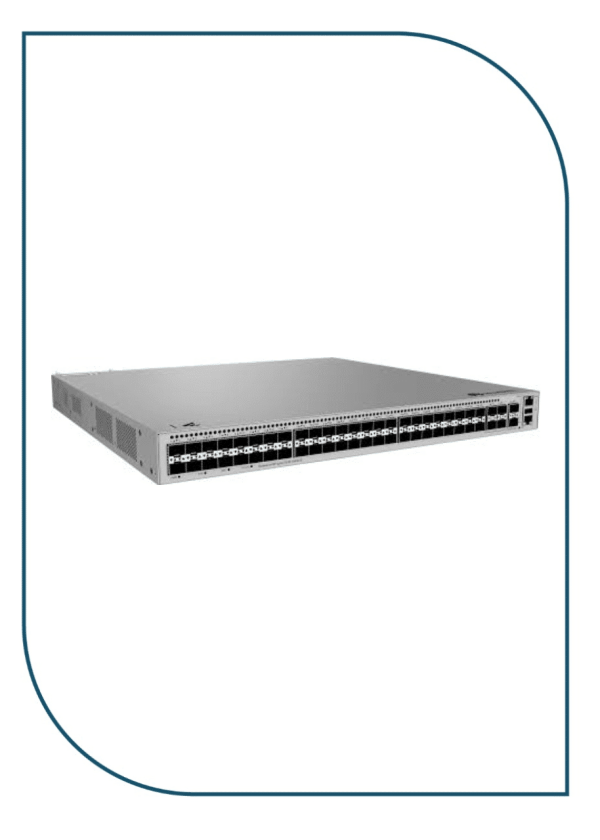
Huawei eKitEngine S530-48S4XE 48-Port GE SFP Aggregation Switch with 4x 10GE SFP+ (S530-48S4XE)
In stock
46.990,00 EGP
SKU:
S530-48S4XE
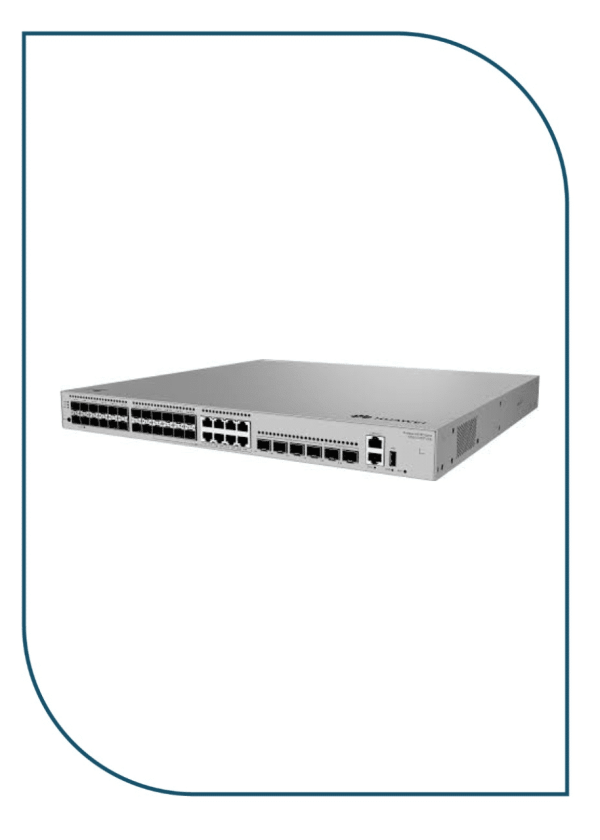
Huawei eKitEngine S530-24ST4XE 24-Port GE SFP Aggregation Switch with 4x 10GE SFP+ (S530-24ST4XE)
In stock
42.950,00 EGP
SKU:
S530-24ST4XE
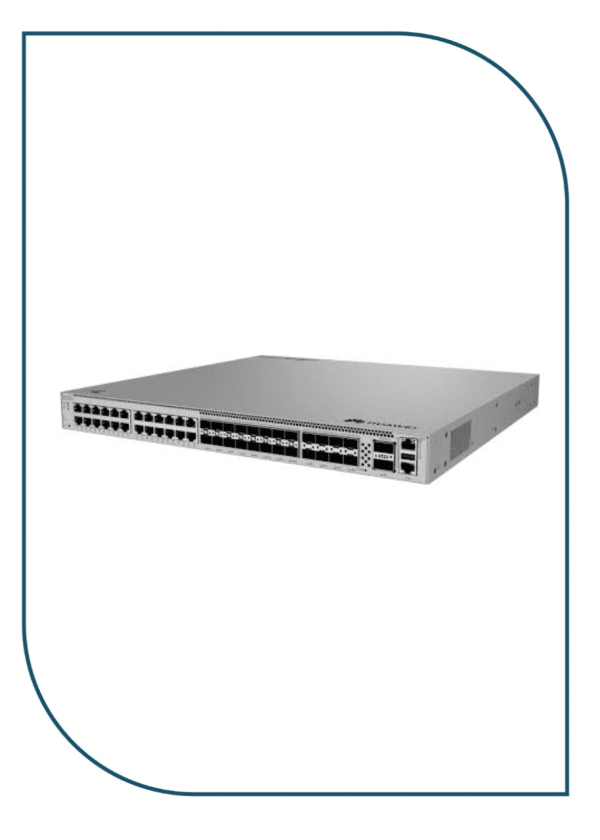
Huawei eKitEngine S620-24T16X8Y2CZ Enterprise Core Switch with 2x 100GE & 8x 25GE (S620-24T16X8Y2CZ)
Available on backorder
90.999,00 EGP
SKU:
S620-24T16X8Y2CZ
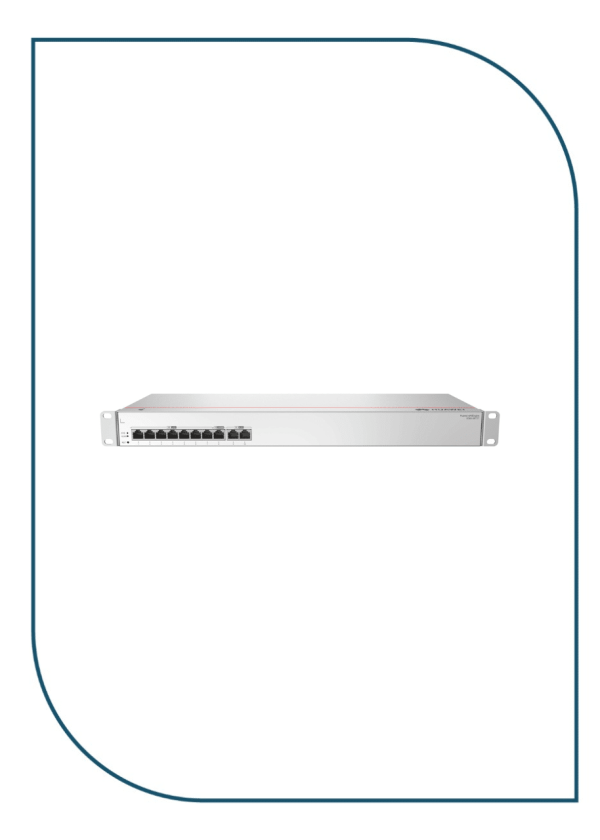
Huawei eKIT S380-S8T2T Multi-Service Gateway with Dual GE WAN Ports (S380-S8T2T)
In stock
10.990,00 EGP
SKU:
S380-S8T2T

Eng. Eslam El Fiky
Co-Founder & Managing Director
Enterprise IT systems specialist and telecom infrastructure strategist. Eng. Eslam oversees BSMART Networks' enterprise hardware distribution, server rack infrastructure, and vendor alliances with global brands like Huawei across Egypt and the MENA region.


